Playback by Mark Coleman
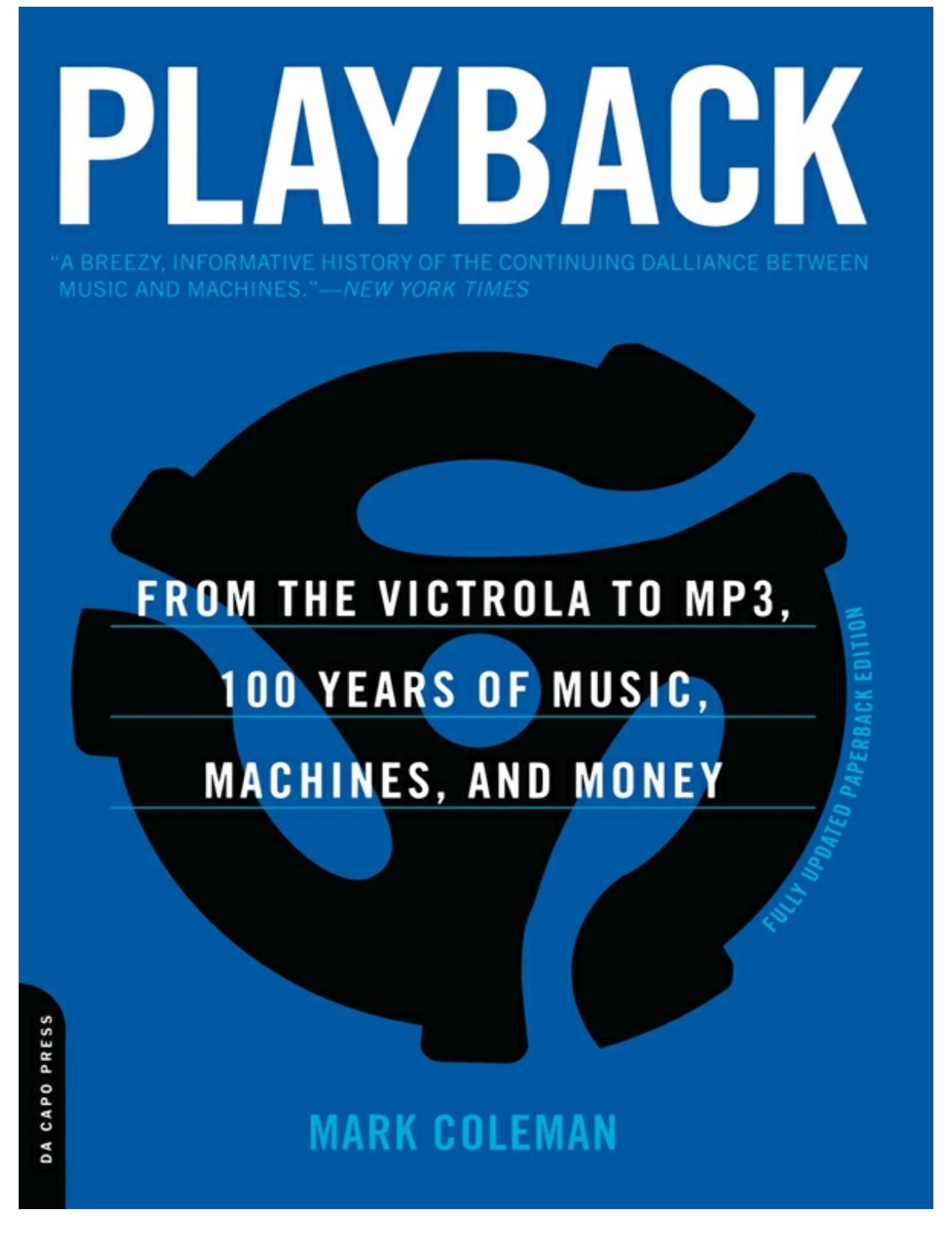
Author:Mark Coleman [MARK COLEMAN]
Language: eng
Format: epub, pdf
Publisher: Da Capo Press
Published: 2012-01-29T05:00:00+00:00
The Big 12-Inch Record
In the smoke and shadow of the night world lived an alternate breed of disc jockey. Ironically, at the height of hippiedom, these DJs plugged into popular music’s primal function—dancing. A new breed of amusement palace had begun to emerge, a place where dancing to records wasn’t a sideshow but rather the main event. And the DJ ruled as musical ringmaster. Leave your preconceptions at the door and enter the disco era.
Disco is the pure musical expression of the phonograph. Generated by DJs in response to dancers, it represents the first popmusic style born and bred at the turntable. Disco began as an underground cult in New York City and developed into a definitive—and divisive—cultural phenomenon in the late seventies. Though it can fairly be labeled a fad, disco permanently changed popular music: not only how it sounds, but also how it’s recorded, marketed, and consumed.
Rhythm rose to rule over melody. The recording studio and its producers and engineers came to dominate the creative process. Sonic manipulation in the studio became an end in itself, rather than a means of reproducing the sound of a live performance. In a discotheque, the reproduction of sound is a live performance.
The ongoing reign of electronically generated music—the endlessly repetitive programs, tape loops, synthesizers, and drum machines pulsing all around us—properly begins in the disco era. Disco returned the turntable to the public sphere, and the result was perhaps the ultimate dance craze. At discotheques from Studio 54 on down, the spotlight focus of celebrity shifted from performer to audience. The mode of enjoyment switched from passive to participatory, from sitting and listening to getting up and dancing. Disco represents the last stand of a certain kind of mass hysteria.
The disco DJs reinvented pop music by taking the existing technology and stretching it a bit. The pitch-adjustment setting on the Technics 1200SL turntable—the DJ’s choice—permitted minute variations on the speed of a spinning record. This allowed for smooth segues—the beat of one song merging into the next, and so on. Still, juggling a batch of 45s in front of a dance floor had to be a tightrope walk; dancers demanded longer songs and losing momentum spelled DJ death. Eventually, a new record format arose to meet the DJs’ (and dancers’) exacting requirements. Cobbled together from existing 45 rpm and LP formats, the 12- inch single, or disco mix, was their ungainly spawn. However inelegant, the new format worked like a charm for DJs: 12-inch singles were not only longer, they sounded better—more dynamic—thanks to the wider grooves. For consumers it would be another story—a record format that fell flat.
Just as disco came to the forefront, the sixties rock revolution flagged. The popularity of black music—the emergent disco sound and Philly soul—reasserted the pop single format as an airplay medium and a unit of public consumption, if not a consumer item. Albums still ruled in record stores: singles accounted for less than 8 percent of the market in 1975. Musically, the next big thing was bubbling under the surface; buyers were restless, clamoring for something new.
Download
This site does not store any files on its server. We only index and link to content provided by other sites. Please contact the content providers to delete copyright contents if any and email us, we'll remove relevant links or contents immediately.
The Great Music City by Andrea Baker(34075)
Aircraft Design of WWII: A Sketchbook by Lockheed Aircraft Corporation(32394)
Call Me by Your Name by André Aciman(20762)
The Secret History by Donna Tartt(19519)
The Art of Boudoir Photography: How to Create Stunning Photographs of Women by Christa Meola(18792)
Shoot Sexy by Ryan Armbrust(17876)
Plagued by Fire by Paul Hendrickson(17561)
Portrait Mastery in Black & White: Learn the Signature Style of a Legendary Photographer by Tim Kelly(17118)
Adobe Camera Raw For Digital Photographers Only by Rob Sheppard(17111)
Photographically Speaking: A Deeper Look at Creating Stronger Images (Eva Spring's Library) by David duChemin(16818)
Ready Player One by Cline Ernest(15180)
Pimp by Iceberg Slim(14825)
Bombshells: Glamour Girls of a Lifetime by Sullivan Steve(14244)
The Goal (Off-Campus #4) by Elle Kennedy(13999)
Art Nude Photography Explained: How to Photograph and Understand Great Art Nude Images by Simon Walden(13163)
Kathy Andrews Collection by Kathy Andrews(12129)
The Priory of the Orange Tree by Samantha Shannon(9402)
The remains of the day by Kazuo Ishiguro(9253)
Thirteen Reasons Why by Jay Asher(9159)
